Evaluating Watercolor Spring Summer Scenery Clipart for Creative Projects
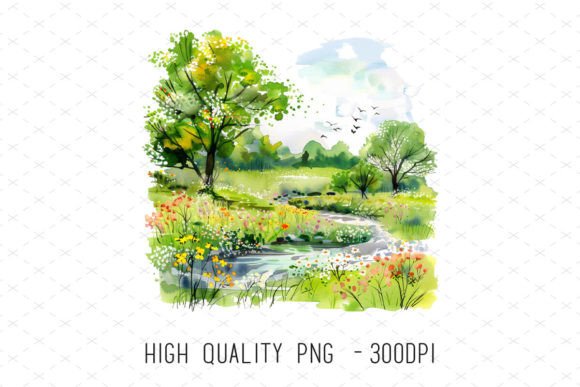
Digital artists, small business owners, and DIY enthusiasts frequently search for visual assets that convey specific seasonal moods without the time investment of creating original illustrations. Watercolor Spring Summer Scenery Clipart has emerged as a popular solution for those needing high-quality, nature-inspired graphics. These digital files typically feature soft, blended hues of green, blue, pink, and yellow, capturing the essence of blooming gardens, sunny skies, and lush landscapes. Understanding the technical specifications and practical applications of these assets is essential before integrating them into commercial or personal projects.
Defining the Asset: Technical Specifications and Quality
When evaluating digital art for production, the file format and resolution are critical factors. The standard offering for this category often includes a high-resolution PNG file, specifically sized at 4000 x 4000 pixels with a resolution of 300 DPI (dots per inch). This specification is significant because it ensures the image remains crisp when printed on physical media. Unlike lower-resolution web graphics, a 300 DPI file supports large-format printing, such as posters or banners, without visible pixelation.
The use of the PNG format is another key consideration. PNG files support transparency, meaning the background is removed, leaving only the artwork. This allows designers to place the scenery over various colored backgrounds, textures, or photographs without an unsightly white box surrounding the image. Furthermore, reputable sources ensure these files come without watermarks, which is a non-negotiable requirement for professional use. A watermark-free asset guarantees that the final product looks polished and ready for immediate deployment.
Practical Applications Across Various Media
The versatility of Watercolor Spring Summer Scenery Clipart lies in its adaptability across different mediums. Because the style mimics traditional hand-painted art, it adds a touch of organic warmth to digital designs. This makes it particularly effective for several specific use cases:
- Print-on-Demand Products: The high resolution makes these clips suitable for sublimation on mugs, t-shirts, and tote bags. The soft edges of watercolor blend well with fabric textures.
- Paper Crafts and Stationery: Invitations, greeting cards, and scrapbooking layouts benefit from the delicate aesthetic. The transparent background allows for layering over patterned paper digitally or physically.
- Web and Digital Design: Website headers, blog post images, and social media graphics can utilize these assets to create a cohesive seasonal theme. They load quickly compared to complex vector files while maintaining visual appeal.
- Home Decor and Signage: Wall art prints and wooden signs often feature this style to evoke a calming, natural atmosphere in living spaces.
Benefits and Advantages for Creators
For individuals looking to streamline their creative workflow, purchasing pre-made clipart offers distinct advantages. The primary benefit is efficiency. Creating a realistic watercolor landscape from scratch requires not only artistic skill but also significant time for painting, drying, scanning, and cleaning up the digital file. By acquiring a ready-made set, creators bypass the production phase and move directly to design and layout.
Another advantage is consistency. When a project requires multiple elements—such as a series of greeting cards or a collection of stickers—using a single clipart pack ensures that the color palette and brushstroke style remain uniform across all items. This visual cohesion is difficult to achieve when mixing assets from different sources or attempting to replicate a handmade look manually. Additionally, the ability to resize the image easily using standard software like Adobe Photoshop, Canva, or Illustrator provides flexibility for adapting one asset to multiple formats.
Tradeoffs and Considerations
While the utility of these digital assets is clear, there are tradeoffs to consider. The most notable limitation is uniqueness. Since clipart packs are sold to multiple buyers, there is a possibility that another creator may use the same image. For brands relying heavily on exclusive identity, this lack of exclusivity might be a concern. It is important to weigh the cost savings against the risk of market saturation if the clipart becomes too common in a specific niche.
Furthermore, the style itself imposes certain aesthetic constraints. Watercolor implies a soft, fluid, and somewhat imperfect look. This style may not align with projects requiring sharp, geometric, or hyper-realistic imagery. If a brand's voice is strictly modern, minimalist, or corporate, the organic texture of watercolor might feel out of place. Designers must evaluate whether the "handmade" vibe complements their overall brand strategy or conflicts with it.
Situations Where Alternatives May Be Preferable
Although Watercolor Spring Summer Scenery Clipart is versatile, it is not the optimal choice for every scenario. If a project involves extreme scaling, such as billboard-sized outdoor advertising, a vector-based illustration (SVG or EPS) might be superior. Vectors are mathematically defined and can be scaled infinitely without any loss of quality, whereas raster images like PNGs have a hard limit based on their pixel dimensions. Even at 4000x4000 pixels, pushing a raster image beyond its intended size can eventually lead to degradation.
Additionally, if the goal is to create a completely unique piece of intellectual property, commissioning a custom artist or creating the art personally is a better route. Custom work ensures total ownership and the ability to modify every detail to fit specific narrative requirements. Similarly, if the project requires photorealism rather than artistic interpretation, stock photography would likely serve the purpose better than stylized clipart.
Decision-Making Insights for Buyers
Before finalizing a purchase or download, potential users should assess their specific needs against the product features. First, verify the licensing terms. Ensure the license covers the intended use, whether it is for personal crafts, commercial print-on-demand, or resale as part of a larger design bundle. Second, test the file locally. Downloading a sample or previewing the transparency can confirm that the edges are clean and the colors match expectations.
Consider the workflow integration as well. Does the file format align with the software you currently use? While PNG is widely supported, some advanced workflows might require layered PSD files for further editing. Finally, think about the longevity of the trend. Seasonal art is inherently tied to a timeframe. Investing in high-quality assets that can be adapted for future seasons or repurposed for general nature themes maximizes the return on investment.
In conclusion, Watercolor Spring Summer Scenery Clipart represents a valuable resource for those seeking to add a seasonal, artistic touch to their projects efficiently. By understanding the technical strengths, aesthetic limitations, and appropriate use cases, creators can make informed decisions that enhance their work while avoiding common pitfalls. Whether for a simple greeting card or a complex branding campaign, the right asset can bridge the gap between concept and execution.