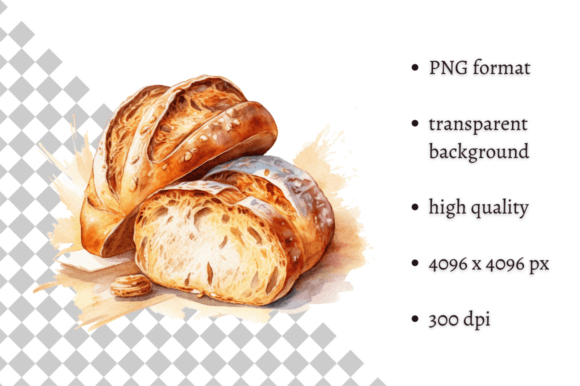
Watercolor Bakery Bread Rolls Clipart: A Practical Guide for Designers
In the realm of digital crafting and graphic design, the choice of visual assets can significantly influence the final aesthetic of a project. Watercolor Bakery Bread Rolls Clipart has emerged as a distinct category within this landscape, offering a specific texture and mood that differs markedly from vector-based or photographic alternatives. For designers, scrapbookers, and small business owners creating branding materials, understanding the nuances of this medium is essential for making informed decisions about resource allocation and artistic direction.
This article examines the characteristics of watercolor bakery illustrations, compares them with other common clipart styles, and evaluates their suitability for various applications ranging from sublimation to paper crafts. The goal is to provide a balanced perspective on when these assets add value and when they might present limitations compared to other options.
Defining the Watercolor Aesthetic in Digital Assets
Watercolor Bakery Bread Rolls Clipart refers to digital images created using software tools that simulate the fluid, translucent nature of traditional watercolor painting. Unlike standard raster images or vector graphics, these files capture the irregular edges, pigment pooling, and soft gradients inherent to the physical medium. When applied to bakery products like bread rolls, croissants, or pastries, the style evokes a sense of warmth, artisanal quality, and nostalgia.
The technical specifications of high-quality sets often include a resolution of 300 dpi and dimensions such as 4096 x 4096 pixels. These parameters ensure that the subtle details of the watercolor washes remain crisp even when printed at larger sizes. Furthermore, the provision of PNG files with transparent backgrounds allows these elements to be seamlessly integrated into complex layouts without the need for additional masking or background removal. This technical foundation supports the artistic intent, preserving the delicate interplay of light and color that defines the watercolor look.
Comparing Styles: Watercolor vs. Vector and Photorealism
When evaluating resources for a bakery-themed project, it is necessary to compare Watercolor Bakery Bread Rolls Clipart against its primary competitors: flat vector illustrations and photorealistic photography. Each format serves different functional and aesthetic purposes.
- Vector Illustrations: Vector graphics are defined by mathematical paths, making them infinitely scalable without loss of quality. They typically feature clean lines and solid colors. While vectors are ideal for logos, signage, and large-format printing where sharpness is paramount, they can sometimes appear too sterile or commercial for projects aiming for a handmade feel.
- Photorealistic Images: High-resolution photographs offer absolute realism. They are effective for menus or packaging where the customer needs to see the exact texture and color of the product. However, photos can be difficult to blend into stylized designs and may require significant editing to match a specific color palette.
- Watercolor Clipart: This style occupies a middle ground. It offers the scalability of a digital asset (within the limits of pixel resolution) while retaining an organic, human touch. The soft edges of watercolor bread rolls allow them to blend more naturally with hand-lettering and textured paper backgrounds than rigid vector shapes would.
The tradeoff lies in versatility versus atmosphere. If a project requires precise geometric alignment or extreme scaling, a vector alternative might be superior. However, if the objective is to convey a cozy, boutique, or rustic brand identity, the watercolor approach provides an emotional resonance that vectors and photos struggle to replicate.
Evaluating Use Cases and Application Scenarios
The utility of Watercolor Bakery Bread Rolls Clipart extends across both digital and physical mediums. Understanding where these assets perform best helps creators avoid mismatches between the tool and the task.
Paper Crafts and Scrapbooking
For enthusiasts of junk journaling, scrapbooking, and card making, the watercolor style is particularly advantageous. The soft textures mimic the look of ink bleeding into paper, creating a cohesive aesthetic when layered over actual paper textures or patterned backgrounds. Because these files are provided in high-resolution PNG formats, they print cleanly on home printers and professional plotters, maintaining the integrity of the brush strokes.
Digital Invitations and Social Media
In the digital space, these clipart elements excel in invitation cards for baby showers, bridal showers, or bakery grand openings. The whimsical nature of the art complements elegant typography and pastel color schemes commonly used in event planning. On social media platforms, where engagement often relies on visual storytelling, the "hand-painted" look stands out against the sea of polished, corporate-style imagery, potentially increasing user interaction.
Sublimation and Merchandise
For those engaged in sublimation printing on mugs, tote bags, or aprons, the transparency of the background is a critical factor. Watercolor Bakery Bread Rolls Clipart allows for direct application onto colored substrates without a white box surrounding the image. The 300 dpi resolution ensures that the fine details of the watercolor wash do not become pixelated during the heat transfer process.
Technical Considerations and Limitations
While the benefits of this style are clear, potential users must also consider the technical constraints. Unlike vector graphics, raster-based watercolor images have a fixed resolution. Although 4096 x 4096 pixels is substantial, enlarging the image beyond its native size will eventually result in pixelation. Therefore, it is crucial to assess the intended output size before committing to a raster asset.
Additionally, the artistic nature of watercolor means that the edges are often soft and irregular. In design scenarios requiring strict grid alignment or precise overlapping with text, this lack of definition can pose challenges. Designers may need to apply slight adjustments to opacity or layer blending modes to ensure legibility and balance. It is also worth noting that the color palette in watercolor art is often muted and blended; achieving vibrant, neon, or highly saturated results may require significant post-processing, which could alter the original charm of the illustration.
Decision Factors: Choosing the Right Resource
Determining whether Watercolor Bakery Bread Rolls Clipart is the right choice depends on several key factors related to the project's goals and audience.
- Brand Identity: Does the brand aim to communicate tradition, warmth, and craftsmanship? If so, watercolor is likely the optimal choice. If the brand focuses on speed, modernity, or industrial efficiency, a vector or minimalist style may be more appropriate.
- Target Audience: Audiences aged 20–50 often appreciate authenticity and artisanal aesthetics. The watercolor style resonates well with consumers who value local businesses, homemade goods, and personalized experiences.
- Production Method: Will the design be printed on textured paper or transferred to fabric? Watercolor assets integrate better with tactile materials than flat vectors. Conversely, for laser-cutting or vinyl cutting, the lack of hard edges makes waterclipart unsuitable.
- Budget and Time: Creating custom watercolor illustrations from scratch is time-consuming and requires specific artistic skills. Purchasing a high-quality set of pre-made clipart offers a cost-effective solution that delivers professional results without the learning curve.
Strategic Integration into Design Workflows
To maximize the impact of these assets, designers should treat them as components of a larger system rather than standalone images. Combining Watercolor Bakery Bread Rolls Clipart with complementary elements—such as hand-lettered fonts, kraft paper textures, or botanical accents—creates a unified visual language. The transparency of the PNG format facilitates this layering, allowing for depth and dimension that static images cannot achieve.
Furthermore, consistency is key. When building a collection of materials, such as a suite of marketing flyers or a series of journal pages, maintaining the same watercolor style across all elements ensures a professional and cohesive presentation. Mixing watercolor bakery items with hyper-realistic food photography, for instance, can create visual dissonance that distracts the viewer.
Conclusion on Selection and Value
Watercolor Bakery Bread Rolls Clipart represents a specialized tool in the designer's toolkit, offering a unique blend of artistic charm and digital convenience. Its strength lies in its ability to evoke emotion and suggest a handmade quality, making it ideal for boutique brands, personal crafts, and event stationery. However, it is not a universal solution; projects demanding extreme scalability, sharp geometric precision, or photorealistic accuracy may require alternative formats.
By carefully weighing the aesthetic goals against the technical requirements of the project, creators can determine if this style aligns with their vision. For those seeking to add a touch of sweetness and sophistication to their work, the delectable charm of high-resolution watercolor illustrations offers a compelling option that balances quality with ease of use. Ultimately, the decision rests on how well the soft, organic nature of the watercolor medium supports the narrative the designer wishes to tell.